

Product Overview
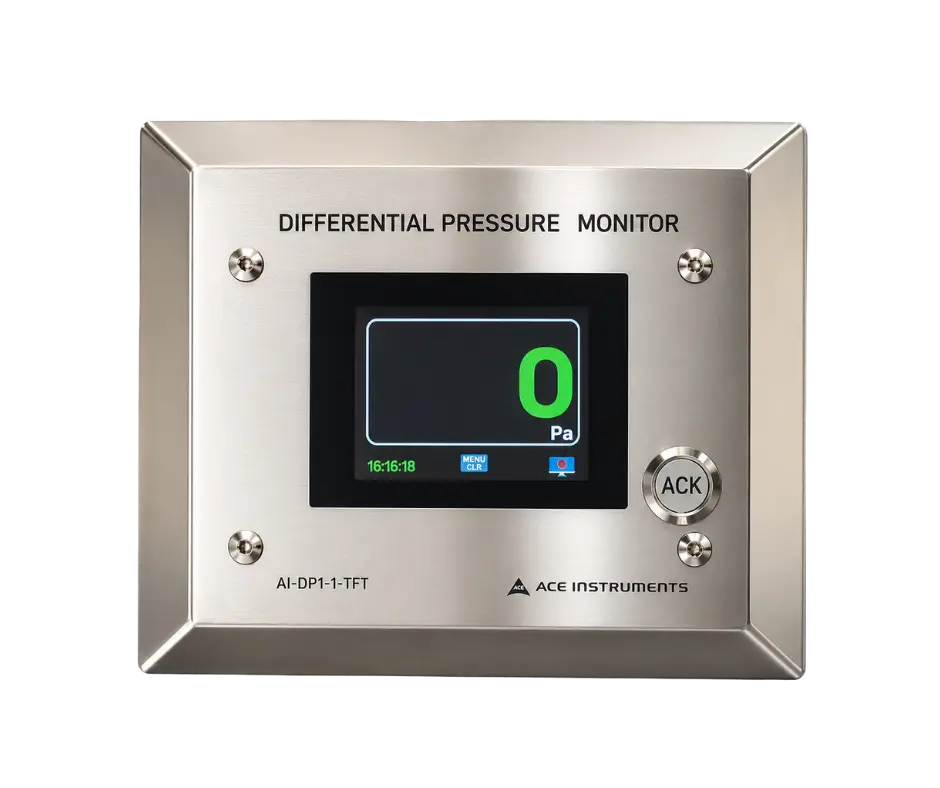
The Ace Instruments Cleanroom Differential Pressure Monitor with TFT Display (AI-DP1-1-TFT) is a digital differential pressure monitor built for laminar air flow cabinets, cleanrooms, biosafety cabinets, and AHU applications. It replaces the needle dial of an analog gauge with a 3 inch TFT screen, and it adds the data outputs that a modern environmental monitoring program or BMS expects, including RS485 Modbus communication.
The instrument has a built-in differential pressure sensor and an integrated high and low buzzer alarm with acknowledgement for process violation alerts.
How It Works
The built-in sensor measures the pressure difference between two points, such as a room and its corridor or a cabinet and its room, and shows the result on a single-row, 3 inch color TFT display. When the reading moves outside its configured range, the reading turns red on screen and the buzzer sounds. Staff acknowledge the alarm by touch once they have seen it. Pressure can be shown in Pascal or mm.W.C., and the unit is switched from the keypad, so no manual conversion is needed. An optional isolated 4 to 20 mA output or isolated RS485 Modbus connection sends the same reading to a BMS, SCADA system, or PLC.
Features
- Built-In Differential Pressure Sensor:
Measures room to corridor or cabinet to room pressure directly, giving a digital reading that can also be logged.
- 3 Inch TFT Screen:
A single-row color display that is easier to read at a distance than a small needle dial.
- Visual Alarm:
The reading turns red during an out of range violation.
- High and Low Buzzer Alarm with Touch Acknowledgement:
Alerts staff when pressure drifts outside its set range.
- Selectable Pressure Units:
Switch between Pascal and mm.W.C. from the keypad.
- Isolated 4 to 20 mA Output (Optional):
Single analog output for BMS, SCADA, or PLC logging.
- Isolated RS485 Modbus Communication (Optional):
Digital integration for facilities that collect environmental monitoring data over Modbus.
- Slim Back Box for Modular Walls:
40 mm deep, so it sits flush in cleanroom wall panels and keeps surfaces smooth and cleanable.
- Modular or Brick Wall Mounting:
A stainless steel front flush plate over an M.S. back box suits new cleanroom builds and retrofits into existing brick walls.
Applications
- Laminar Air Flow Cabinets:
Confirms the pressure differential that keeps unidirectional airflow protecting the work zone from surrounding room air.
- Cleanrooms:
Monitors room to corridor pressure cascades, which stop a classified space from being contaminated by, or contaminating, its neighbors.
- Biosafety Cabinets:
Verifies the pressure relationship that keeps hazardous material contained and protects operators.
- Air Handling Units (AHUs):
Tracks pressure across filter banks or system stages, giving an early sign of filter loading or fan problems.
- Pharmaceutical Cleanrooms and GMP Production Areas:
Supports the continuous pressure cascade evidence that GMP facilities keep for batch records and inspection readiness.
- Hospital Isolation Rooms and Operating Theatres:
Confirms the negative or positive pressure required for infection control in sterile and isolation environments.
- ISO Classified Cleanrooms:
Provides ongoing pressure evidence between formal requalification tests.
- Pass Boxes and Airlocks:
Monitors the pressure relationship at transfer points between zones of different cleanliness.
Why Differential Pressure Monitoring Matters in Cleanrooms
Pressure cascades are what physically keep contamination from moving between spaces, whether the goal is to protect a product from its surroundings or to contain a hazard inside the room. On an analog gauge, a drift can go unnoticed until someone walks past and happens to check it. Continuous digital monitoring with an audible alert and a red on-screen warning catches the drift as it happens, before it becomes a deviation that has to be investigated afterward.
Understanding Pressure Cascades
A pressure cascade is the planned pressure difference between adjoining rooms that makes air always flow from cleaner areas toward less clean ones. A typical pharmaceutical sequence looks like this:
- Grade B to Grade C
- Grade C to Grade D
- Clean corridor to service corridor
Each step in the sequence needs its own differential pressure to hold. One monitor at each boundary shows whether the whole cascade is intact, and a drop at a single boundary shows where the problem started.
Positive and Negative Pressure Monitoring
The monitor measures the difference between two locations, so the same instrument serves both pressure directions.
- Positive pressure rooms, such as cleanrooms and operating theatres, keep corridor air out of the protected space.
- Negative pressure rooms, such as isolation rooms, biosafety laboratories, and containment areas, keep hazardous air from escaping into adjacent spaces.
Which direction applies to a room comes from your design and validation documents, and the alarm limits are set to match.
Choosing the Right Pressure Range
The standard range is -100 to +100 Pascal using the built-in sensor, which covers differentials in both directions. Other ranges can be supplied to requirement. Cleanroom cascades are usually small compared with the span of the sensor, and many facilities cite figures in the 10 to 15 Pa range between adjacent grades, though your own protocol defines the exact value. If your application involves much larger pressures, such as filter pressure drop in an AHU, tell us the expected values so we can confirm the right range before you order.
Alarm Behavior and Acknowledgement
The monitor warns in two ways at once. The reading turns red on the display, and the buzzer sounds for a high or low violation. Staff acknowledge the alarm by touch, which silences the buzzer after the condition has been noted. When an alarm sounds, the usual causes to check are an open door, a fan failure, a blocked filter, or an HVAC fault. Checking these quickly can bring the room back into range before contamination becomes a risk.
Compliance
The AI-DP1-1-TFT is built to support the pressure monitoring expectations of classified and GMP regulated facilities. It does not replace your qualification protocol.
- ISO 14644-2 Continuous Monitoring:
Differential pressure is one of the parameters that ISO 14644-2 expects to be monitored on an ongoing basis between formal requalification cycles. The continuous digital reading, buzzer alert, and optional outputs support that evidence trail.
- ISO 14644-3 Qualification Testing:
Differential pressure is measured during Installation, Operational, and Performance Qualification. The offset provision and 4 to 20 mA output help align continuous readings with what your qualification protocol tests at a point in time.
- GMP and EU Annex 1 Documentation:
Pressure cascades between classified areas are a documented requirement under EU GMP Annex 1 and related guidelines. The Modbus or 4 to 20 mA output sends pressure data to your BMS or SCADA system, which can time stamp and store it as a record for batch files and inspections.
- ISO 9001:2015:
Ace Instruments manufactures the AI-DP1-1-TFT under an ISO 9001:2015 certified quality management system.
The acceptable pressure range for your facility is not fixed by ISO 14644 itself. Your product, process, or classification requirement defines it, and the monitor's role is to measure and alert consistently against whatever range your validation protocol sets.
Integration
The AI-DP1-1-TFT connects to Building Management Systems (BMS), PLC based automation, SCADA systems, and cleanroom monitoring platforms through its isolated 4 to 20 mA output or RS485 Modbus communication. Pressure data then sits alongside your temperature and humidity records in one system.
Benefits
- Clear, At a Glance Reading:
The 3 inch color screen is easier to read from a distance than a small analog dial.
- Immediate Alert on Set Point Violation:
The buzzer and red display notify staff the moment pressure drifts out of range, not only when someone checks the BMS.
- Straightforward System Integration:
The 4 to 20 mA and RS485 Modbus options feed existing BMS, SCADA, or PLC systems without complex rewiring.
- Built for Cleanroom Wall Fitment:
The slim back box keeps wall surfaces smooth and easy to clean.
Choosing Between Display and Enclosure Variants
Ace Instruments offers this differential pressure monitor in several display and enclosure formats. They share the same job, which is measuring pressure, alarming on violations, and passing data to your systems. The choice is mostly about what you want to see on the wall.
VariantDisplayBest forAI-DP1-1 and AI-DDPG4 digit LED readoutA simple numeric readingDifferential Pressure Indicator (LCD)Backlit graphic LCDA clear display with engineering unitsAI-DP1-1-TFT (this model)3 inch color TFTA visual alarm that turns red and reads from a distanceDDPG TFTTFT displayThe same visual alarm where the DDPG enclosure format is specified.
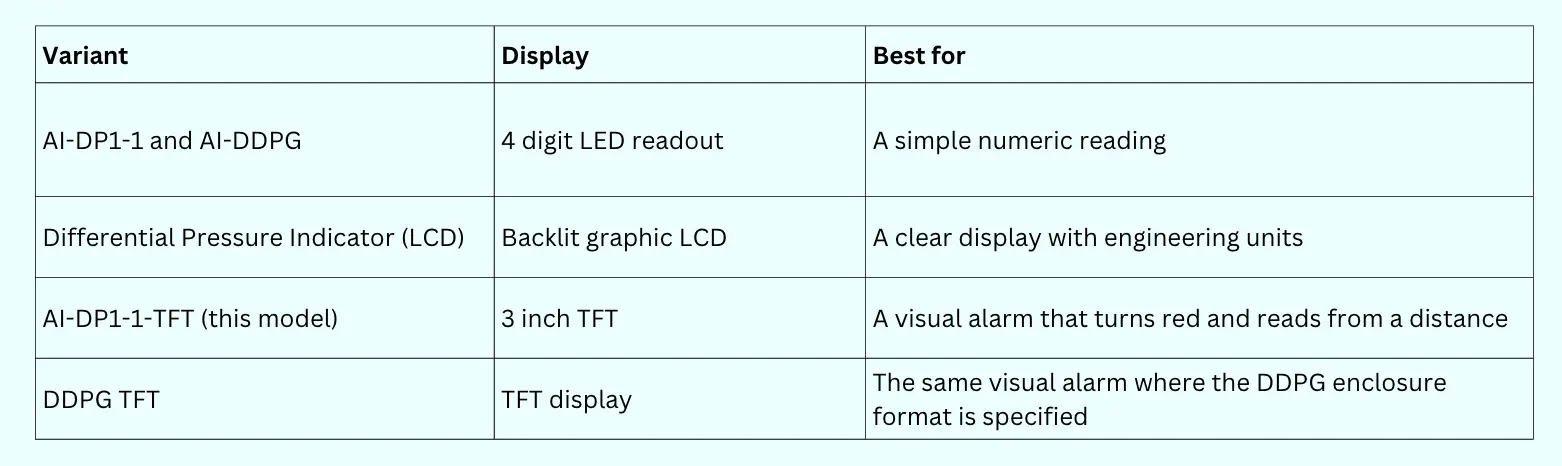
None of these is a functional upgrade over the others. Confirm output options for the specific model you choose.
Specifications
{{table-component}}
Frequently Asked Questions
1. What is the Cleanroom Differential Pressure Monitor AI-DP1-1-TFT?
The AI-DP1-1-TFT is a digital differential pressure monitor designed for continuous monitoring of pressure differences in cleanrooms and controlled environments. It features a TFT display that provides a clear, easy-to-read indication of the measured differential pressure and helps operators verify that the cleanroom is maintaining the required pressure relationship with adjacent areas.
2. Why is differential pressure important in a cleanroom?
Differential pressure helps control the direction of airflow between rooms with different cleanliness classifications. Maintaining the required pressure differential helps prevent unwanted air movement from less-controlled areas into critical clean spaces and supports the overall contamination-control strategy.
3. What does the AI-DP1-1-TFT actually measure?
The monitor measures the difference in air pressure between two locations. One pressure connection is connected to the higher-pressure reference and the other to the lower-pressure reference. The instrument calculates and displays the resulting differential pressure.
4. How does the TFT display help cleanroom operators?
The TFT screen provides a more informative local interface than a basic numerical indicator. Operators can quickly view the current pressure reading and see whether the monitored condition is within the required operating range, because the reading turns red during a violation. This is useful during routine cleanroom checks, production activities, and environmental monitoring.
5. Where should the AI-DP1-1-TFT be installed?
The monitor is normally installed at a convenient location where cleanroom personnel can easily observe the pressure reading. The pressure sensing connections should be routed correctly to the monitored rooms, with suitable tubing and installation practices used to avoid leaks or unnecessary pressure fluctuations.
6. How should the pressure tubing be installed?
The pressure tubing should be properly connected to the high and low pressure points, kept free from kinks and leaks, and routed in a way that minimizes mechanical damage or unwanted pressure effects. Correct tubing installation is essential for obtaining reliable differential pressure readings.
7. Can the monitor be installed in modular cleanroom panels?
Yes. The back box is approximately 40 mm deep, which suits modular cleanroom wall installations as well as conventional brick walls.
8. Can the monitor be used between a cleanroom and a corridor?
Yes. It can monitor the pressure relationship between a cleanroom and an adjacent corridor, airlock, gowning room, or other reference area. The appropriate pressure connection arrangement depends on which space is intended to be maintained at the higher pressure.
9. Can it be used for negative-pressure rooms?
Yes. Differential pressure monitoring is also important for rooms designed to operate at negative pressure. In such applications, the monitor helps operators verify that the room remains at the required pressure relationship relative to the surrounding area.
10. How does the monitor help identify cleanroom pressure problems?
A change in differential pressure can indicate issues such as insufficient supply or exhaust airflow, door-opening effects, HVAC imbalance, filter loading, or problems with the room pressure-control system. Continuous monitoring allows operators to identify abnormal conditions earlier than periodic manual checks alone.
11. Can pressure alarms be configured?
Yes. The monitor has built-in high and low alarms with a buzzer and touch acknowledgement, and the reading turns red during a violation. This is particularly useful for cleanrooms where maintaining a defined pressure differential is part of the environmental-control procedure.
12. Can pressure be shown in Pascal or mm.W.C.?
Yes. Users can switch between Pascal (Pa) and millimetres of water column (mm.W.C.) from the keypad, so the display can match your validation procedures or operating standards.
13. What should be considered when selecting the pressure range?
The selected range should cover the normal operating differential pressure while providing sufficient resolution for meaningful monitoring. A range that is unnecessarily large can reduce the ability to observe small pressure changes, while an unsuitable range may not adequately cover the operating condition.
14. Can the AI-DP1-1-TFT be connected to a Building Management System?
Yes. The monitor can be configured for integration with building automation and monitoring systems using the available communication or output options. This allows cleanroom pressure information to be viewed centrally and used for alarms, trending, documentation, or HVAC control.
15. Does the monitor support RS485 Modbus communication?
RS485 Modbus communication can be provided for applications requiring digital integration with a BMS, PLC, SCADA system, or other automation platform. The exact communication configuration should be confirmed based on the required model specification.
16. Can the monitor be used for continuous 24×7 monitoring?
Yes. The AI-DP1-1-TFT is intended for continuous differential pressure monitoring in controlled environments. Continuous monitoring is particularly useful where cleanroom pressure must be maintained throughout production, storage, testing, or other controlled operations.
17. What types of facilities can use this monitor?
The AI-DP1-1-TFT is suitable for pharmaceutical manufacturing areas, laboratories, hospitals, operation theatres, isolation rooms, biotechnology facilities, medical-device manufacturing, electronics manufacturing, and other controlled environments where differential pressure monitoring is required.
18. Can it be used in different cleanroom classifications?
Yes. The monitor can be applied to cleanrooms with different pressure-control requirements. The appropriate pressure range and configuration should be selected according to the room classification, HVAC design, operating pressure differential, and monitoring requirements.
19. How does the AI-DP1-1-TFT support cleanroom compliance?
The monitor provides continuous local measurement of differential pressure, helping operators verify that the room is operating within its defined pressure limits. When connected to a centralized monitoring system, pressure values can also be monitored and recorded for facility management, investigation, and quality documentation.
20. Does the monitor require calibration?
Yes. Differential pressure instruments should be periodically verified and calibrated according to the application's accuracy requirements and quality procedures. The recommended calibration interval depends on the criticality of the application, operating conditions, and the facility's monitoring program.
21. Can the monitor replace manual differential pressure checks?
It can reduce the need for frequent manual readings by providing continuous local monitoring. However, organizations should continue to follow their established cleanroom procedures for verification, calibration, documentation, and periodic checks as required by their quality system and applicable standards.
22. What is the difference between a differential pressure indicator and a differential pressure monitor?
A differential pressure indicator primarily provides a local pressure reading, while a digital monitor can provide additional functions such as a TFT display, alarm indication, communication, and integration with automation systems. The AI-DP1-1-TFT is intended as a monitoring solution for cleanroom pressure conditions rather than simply a mechanical pressure gauge.
23. What is the difference between the AI-DP1-1-TFT and the LED version?
Both measure differential pressure and alarm on violations. The AI-DP1-1-TFT shows the reading on a 3 inch TFT screen that turns red during an alarm, while the LED version shows a 4 digit numeric readout. Choose the TFT when you want a visual alarm that is readable from a distance.
24. Who typically uses the AI-DP1-1-TFT?
Typical users include cleanroom facility managers, pharmaceutical manufacturers, HVAC contractors, cleanroom consultants, validation teams, QA and QC personnel, hospital engineering teams, laboratory managers, and building automation integrators.
25. What are the main benefits of the AI-DP1-1-TFT?
The monitor provides clear digital pressure indication, convenient TFT-screen visualization, continuous monitoring, suitability for positive and negative pressure applications, and options for integration with building automation systems. It provides a practical way to monitor critical pressure relationships in cleanrooms and controlled environments.
26. How do I select the right cleanroom differential pressure monitor?
Selection should consider the required differential pressure range, display requirements, alarm functions, communication method, output requirements, installation location, and cleanroom application. The Cleanroom Monitors team can help identify the appropriate configuration based on the room pressure requirements and HVAC design.
Gain insight into your IAQ solution and know technical specifications