


Product Overview
The AI-32 is a mechanical differential pressure switch for cleanroom pressure control, isolation room monitoring, HVAC filter monitoring and airflow applications. When the differential pressure reaches a preset switching point, it changes the state of an electrical contact. Connected alarms, control panels, BMS systems or HVAC equipment can then respond immediately.
It is the right choice when you need a dependable alarm or interlock signal rather than a continuous pressure reading. The setpoint is adjusted in the field on a calibrated scale, so facility teams can set it on site without a separate manometer. A transparent protective cover guards the setting against accidental changes, and the IP54 enclosure suits cleanroom anterooms, gowning areas and adjacent mechanical spaces.
How It Works
- Two hose connections carry the high and low pressure sides to the switch.
- The mechanical sensing element reacts to the pressure difference between the two points. No electrical power is needed for sensing.
- When the differential pressure reaches the set point, the electrical contact changes state.
- The connected alarm, BMS, PLC, panel or HVAC interlock reads the change and takes action.
The switch senses a pressure difference, so it works for both positive pressure and negative pressure rooms, depending on how the connections and setpoint are configured. Electrical power is needed only for the external device being switched.
Features
- Mechanical switching with no power for sensing:
Pressure detection is purely mechanical, so the sensing function does not depend on an electrical supply.
- Field adjustable setpoint:
The switching point is set on the integral calibrated scale during commissioning or requalification, without separate calibration tools.
- Transparent protective cover:
The setting stays visible but is protected from accidental or unauthorized adjustment.
- IP54 enclosure:
Protects against dust ingress in anterooms, gowning areas and mechanical spaces.
- Multiple ranges:
Available from 0 to 100 Pa up to 0 to 1000 Pa, in positive only and compound versions, with custom ranges on request.
- Air and non-corrosive gas compatible:
Suited to standard cleanroom and HVAC service conditions.
- Continuous duty design:
Built for permanent installation in pharmaceutical, healthcare, laboratory and industrial facilities.
- Compact installation:
Fits AHUs, ducts and cleanroom wall penetrations without major retrofit work.
Applications
- Cleanroom pressure cascade monitoring:
Installed between adjoining cleanrooms, corridors, airlocks or gowning areas to confirm the required pressure relationship. It triggers an alarm when the differential crosses the set threshold.
- Isolation room pressure alarms:
Monitors negative pressure (infectious) and positive pressure (protective) rooms against the adjoining corridor, and signals when the pressure state is lost.
- Operating theatre and ICU pressure monitoring:
Confirms that controlled hospital spaces hold the pressure relationship set for them.
- HEPA and terminal filter blockage detection:
As a filter loads with particles, the pressure drop rises. The switch signals when it reaches the level you set, so maintenance can be planned.
- AHU filter monitoring:
Gives a maintenance signal for bag and panel filters in air handling units when pressure drop passes the chosen limit.
- Fan status and airflow proving:
Detects the loss of expected pressure difference from a fan failure or airflow reduction, and changes state to activate an alarm or control circuit.
- Airlock and gowning room verification:
Confirms correct pressure staging in the spaces that form part of the cleanroom cascade.
- BMS, PLC and alarm panel integration:
The contact output connects to building management systems, PLCs and alarm panels, which interpret it as a normal or alarm state.
- HVAC safety interlocks:
Supplies a switching signal for fan, damper and ventilation alarm circuits, provided the load is matched to the connected equipment.
Industries Served
- Pharmaceutical manufacturing:
Monitors the pressure cascade between processing rooms, airlocks and corridors, and gives an alarm signal when a room leaves its set pressure relationship.
- Biotechnology facilities:
Watches pressure in controlled production and laboratory areas where containment and cleanliness depend on airflow direction.
- Hospitals:
Signals pressure loss in isolation rooms, operating theatres and intensive care areas.
- Laboratories:
Confirms the pressure relationship between lab spaces and adjoining corridors, and supports fume and ventilation alarms.
- Electronics manufacturing:
Protects cleanroom pressurization and gives early warning of filter loading in the air handling system.
- Medical device manufacturing:
Supports pressure control in assembly and packaging cleanrooms.
- Food processing facilities:
Monitors pressure between clean and less clean zones, and signals filter blockage on ventilation units.
- HVAC installations:
Provides filter alarms, fan status detection, airflow proving and safety interlocks.
Switch vs Monitor vs Transmitter
Choose the device by what the application needs to do.
Use the AI-32 when you need a simple, dependable alarm or interlock. Choose a monitor or transmitter when operators need to see or trend the actual pressure value.
.webp)
Selection Guide
The ranges below are typical starting points only. Always confirm the final choice against your facility's design pressures and the filter manufacturer's final pressure drop.
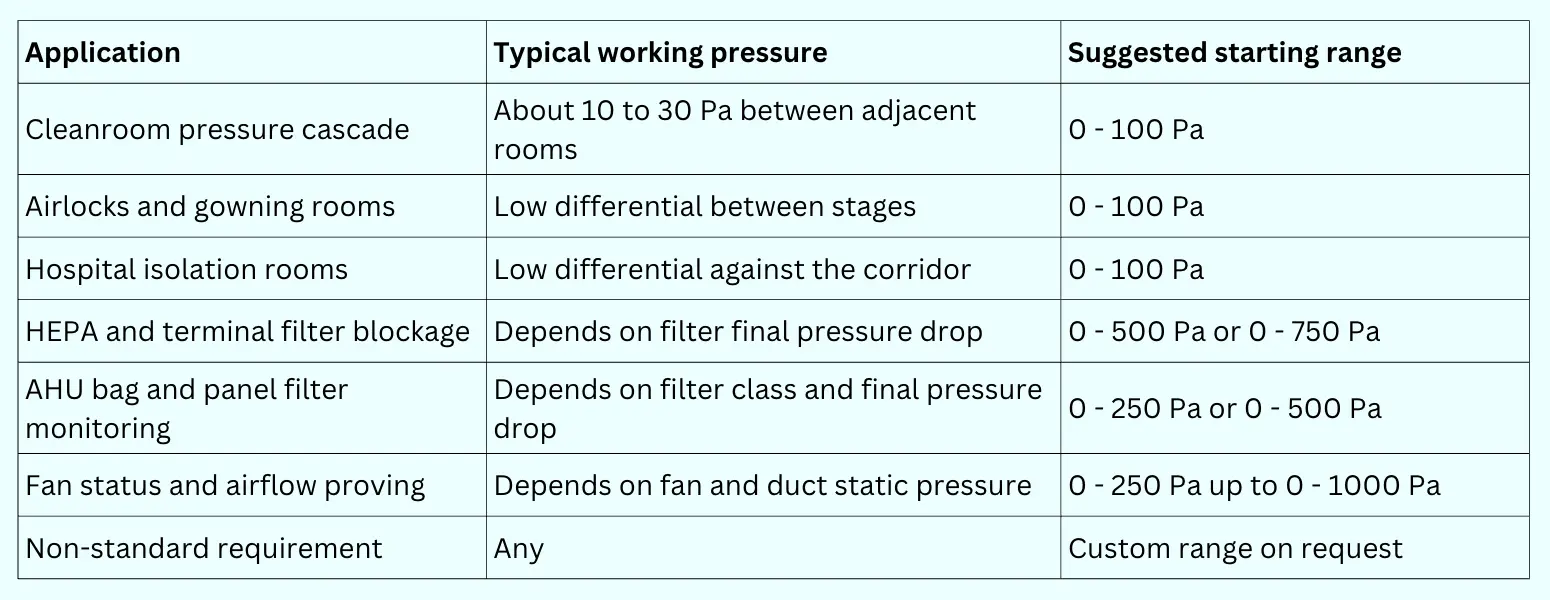
For low setpoints, choose the smallest range that covers your value so the setting sits comfortably on the calibrated scale.
Installation and Mounting
- Pressure ports: Connect the high pressure port to the space or point expected to be at the higher pressure, and the low pressure port to the reference point. Correct connection is needed for the intended switching action.
- Placement between rooms: For a cascade alarm, take one sensing point from each side of the wall, door or airlock being monitored. For filters, connect across the upstream and downstream sides.
- Tubing: Use suitable hose on the two hose connections. Keep runs as short as practical, avoid kinks and trapped moisture, and keep both lines routed in a similar way.
- Location: Mount the switch in an accessible position where the calibrated scale and cover can be seen, away from strong vibration.
- Electrical connection: Wire the contact output to the alarm, BMS input, PLC or control circuit. Match the switching load to the connected equipment.
- After installation: Set the switching point on the scale and check the response against your commissioning procedure.
Specifications
{{table-component}}
Compliance and Quality
The AI-32 is designed and manufactured by Ace Instruments, an ISO 9001:2015 certified manufacturer of industrial instrumentation. It is intended to support pressure monitoring in facilities that work to recognized cleanroom and healthcare standards, such as ISO 14644, EU GMP Annex 1, HTM 03-01 and ASHRAE 170. The final pressure setpoints must follow each facility's own design and qualification requirements.
- IP54 enclosure protection
- Setpoint verification supports periodic checks within a facility's maintenance and qualification program
- Add CE, RoHS or other marks here only if you hold the certificates for this model
- Add calibration or test certificate availability here if offered
Frequently Asked Questions
1. What is the AI-32 Differential Pressure Switch?
The AI-32 is a mechanical differential pressure switch designed for cleanroom pressure control, isolation room monitoring, HVAC filter monitoring, and airflow applications. It changes the state of an electrical contact when the differential pressure reaches a preset switching point, allowing connected alarms, control panels, BMS systems, or HVAC equipment to respond immediately.
2. How is a differential pressure switch different from a differential pressure monitor?
A differential pressure switch is designed primarily for ON/OFF switching. Instead of continuously displaying a pressure value, it changes its electrical contact when the pressure reaches the configured threshold. This makes it particularly useful for alarms, fan interlocks, filter blockage alerts, and pressure limit detection.
3. Why is a pressure switch useful in a cleanroom?
Cleanrooms often depend on controlled pressure relationships between adjacent spaces. The AI-32 can provide an immediate electrical signal when the pressure moves beyond the selected switching point, helping operators detect loss of pressure control before it becomes a larger HVAC or contamination control issue.
4. Can the AI-32 be used to monitor a cleanroom pressure cascade?
Yes. The switch can be installed between adjoining cleanrooms, corridors, airlocks, or gowning areas to monitor whether the required pressure relationship is maintained. It can trigger an alarm when the differential pressure crosses the configured threshold.
5. Can the AI-32 monitor both positive and negative pressure rooms?
Yes. The switch senses the pressure difference between two points and can be used for both positive pressure and negative pressure applications, depending on how the pressure connections and switching point are configured.
6. Can it be used for HEPA filter blockage detection?
Yes. As a HEPA or bag filter becomes loaded with particles, the pressure drop across the filter generally increases. The AI-32 can be set to switch at a selected pressure level and provide an alarm or maintenance signal when the pressure drop reaches that level.
7. Can the AI-32 detect loss of airflow from an AHU or fan?
Yes. The pressure switch can be used as an airflow proving or fan status device. If the expected pressure difference is lost because of fan failure, airflow reduction, or another HVAC problem, the switch can change state and activate the connected alarm or control circuit.
8. Can the switch be used for hospital isolation rooms?
Yes. The AI-32 can be used for positive and negative pressure applications such as isolation rooms, operating theatres, intensive care areas, and other controlled hospital spaces where pressure relationships need to be monitored.
9. How is the switching pressure adjusted?
The switching point can be adjusted in the field using the built-in adjustment mechanism and calibrated scale. This allows the installer or facility team to configure the switch according to the cleanroom, filter, or HVAC application without requiring a separate manometer for the adjustment process.
10. Does the AI-32 need an external power supply?
No. The pressure sensing and switching mechanism is mechanical and does not require electrical power to detect the pressure difference. The electrical circuit is used to switch the connected alarm, controller, BMS input, or other external equipment.
11. Can the AI-32 be connected to a BMS?
Yes. The electrical contacts of the switch can be connected to a BMS, PLC, alarm panel, or HVAC control system. The connected system can then interpret the switch condition as a normal or alarm state and take the appropriate action.
12. Can the AI-32 directly control a fan or damper?
The switch can provide an electrical switching signal to a suitable control circuit. This signal can be used as part of a fan, damper, alarm, or HVAC interlock system. The actual switching load and control arrangement should be matched to the connected equipment.
13. What pressure ranges are available?
The AI-32 is available in multiple ranges, including 0 to 100 Pa, 0 to 250 Pa, 0 to 500 Pa, 0 to 750 Pa, and 0 to 1000 Pa configurations. Both positive only and compound ranges are available for the specified configurations, and custom ranges can be requested.
14. What pressure range is normally suitable for cleanroom applications?
The appropriate range depends on the cleanroom pressure cascade and the particular monitoring point. Pharmaceutical cleanrooms commonly operate with pressure differences of approximately 10 to 30 Pa between adjacent rooms, but the actual switching point should always be selected according to the facility's design and operating requirements.
15. What type of pressure connection does the AI-32 have?
The switch is provided with two hose connections for the high and low pressure sides. Correct connection of these ports is important for obtaining the intended switching action.
16. Is the AI-32 suitable for continuous operation?
Yes. The AI-32 is designed for continuous duty pressure switching in cleanroom, HVAC, pharmaceutical, healthcare, laboratory, and industrial applications. Routine inspection of the pressure tubing and verification of the switching point are recommended as part of normal maintenance.
17. Does the AI-32 require regular calibration?
The switching point should be periodically checked as part of the facility's maintenance and qualification procedures. The frequency of verification depends on the criticality of the application and the cleanroom's quality and maintenance program.
18. What happens when the cleanroom pressure falls below the setpoint?
When the differential pressure reaches the configured switching threshold, the AI-32 changes the state of its electrical contact. This signal can then activate an audible alarm, warning light, BMS input, PLC, or HVAC interlock, allowing the facility team to investigate the pressure deviation.
19. Can the AI-32 be used in airlocks and gowning rooms?
Yes. Airlocks and gowning areas often form part of a cleanroom pressure cascade. The AI-32 can be used to verify the pressure relationship between these spaces and provide a switching signal when the pressure moves outside the configured limit.
20. What type of media can the AI-32 measure?
The AI-32 is intended for air and clean, non-corrosive gaseous media. This makes it suitable for typical cleanroom and HVAC pressure switching applications.
21. Is the AI-32 protected against dust ingress?
The switch has an IP54 rated enclosure. This provides protection against dust ingress suitable for applications such as cleanroom anterooms, gowning areas, and adjacent HVAC or mechanical spaces.
22. What are the main applications of the AI-32?
The AI-32 can be used for cleanroom pressure alarms, pressure cascade control, HEPA and terminal filter monitoring, AHU filter monitoring, fan status detection, airflow proving, isolation room pressure monitoring, ventilation alarms, and HVAC safety interlocks.
23. Which industries commonly use the AI-32?
Typical applications include pharmaceutical manufacturing, biotechnology, hospitals, laboratories, electronics manufacturing, medical device manufacturing, food processing facilities, and HVAC installations requiring differential pressure switching.
24. How do I choose the right AI-32 configuration?
Selection should be based on the normal operating differential pressure, required switching point, application type, pressure range, connection arrangement, and the alarm or control system being used. For cleanrooms, it is particularly important to select a range that provides an appropriate switching point for the required pressure cascade.
25. Why choose the AI-32 for cleanroom pressure switching?
The AI-32 combines mechanical pressure switching, field adjustable setpoints, a calibrated scale, compact installation, IP54 protection, and compatibility with air and non-corrosive gases. Its simple ON/OFF switching approach makes it useful when the application requires a reliable pressure alarm or interlock rather than continuous pressure trending.
26. Which differential pressure switches can the AI-32 be used as a cross-reference for?
The AI-32 is suitable for applications with pressure ranges and switching characteristics similar to many commonly used differential pressure switches, including:
- Siemens QBM81 series (QBM81-3, QBM81-5, QBM81-10, QBM81-20)
- Dwyer® 1910/1900 Series (1910-0, 1910-2, 1910-1, 1910-5, 1910-10, 1910-20)
- Johnson Controls P233A Series (P233A-4, P233A-10)
- Honeywell EDPS Series
- Honeywell DPS Series (DPS200, DPS400, DPS500, DPS1000, DPS2500)
Disclaimer: The comparisons above are cross-reference groupings based on overlapping pressure ranges and switching specifications. They are not direct or certified equivalence claims. ACE Instruments is an independent manufacturer and is not affiliated with, or endorsed by, Siemens, Dwyer® Instruments, Johnson Controls, or Honeywell. Model numbers from those brands are used here purely for range matching reference, not as interchangeability guarantees.
Gain insight into your IAQ solution and know technical specifications