

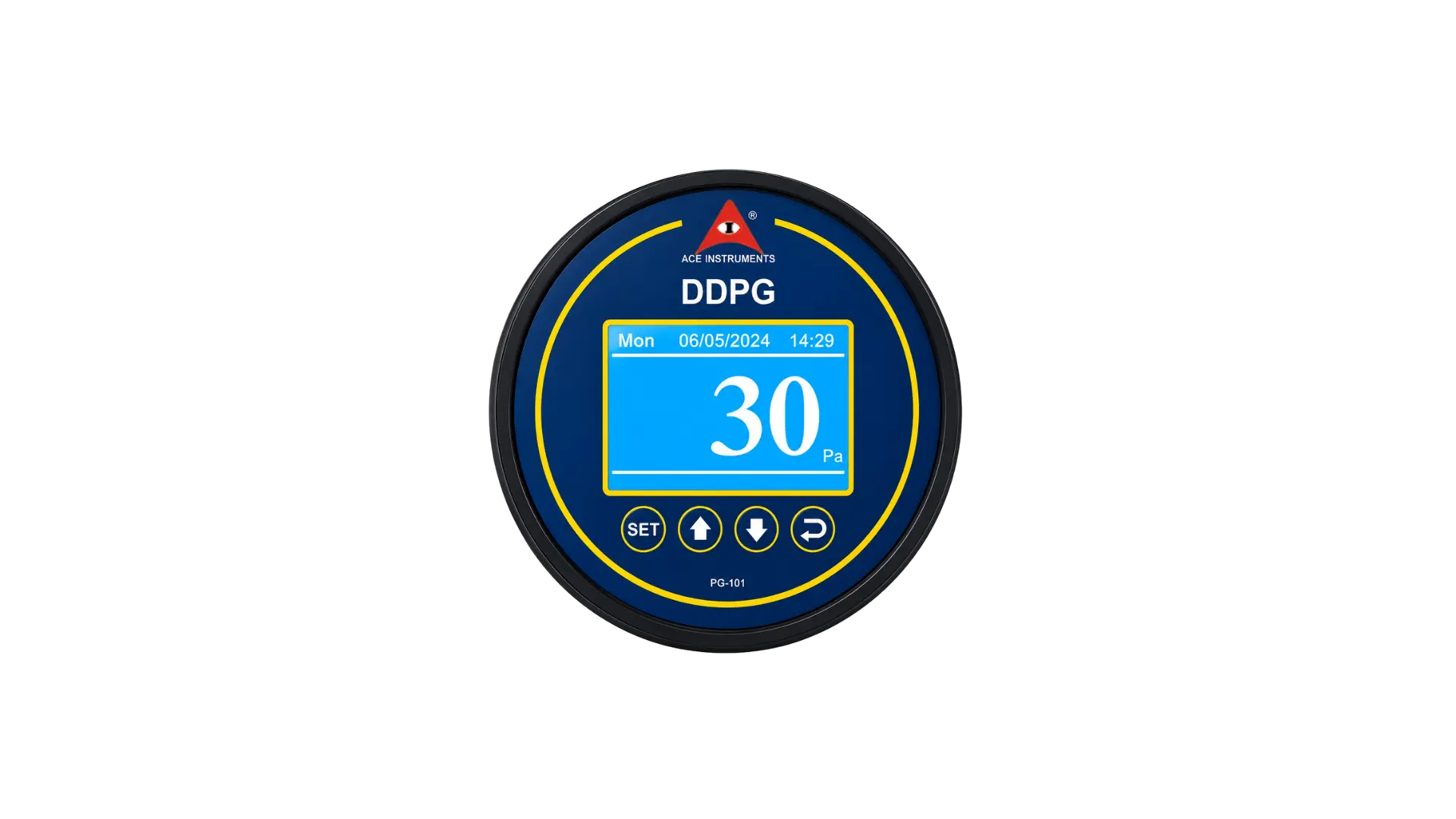
Fits the Magnehelic® cutout, and adds an alarm you can see from across the room. A 3 inch TFT gauge that turns its reading red the moment pressure leaves its limits, with RS485 Modbus and a 4 to 20 mA output behind it.
Description
The DDPG-TFT (Model: PG-101) is a digital differential pressure gauge designed to fit the standard Magnehelic® gauge cutout. That makes it a natural upgrade for cleanrooms, biosafety cabinets, hospital isolation rooms, operating theatres, and air handling units (AHUs).
An analog gauge simply displays a reading. The DDPG-TFT goes further. Its 3 inch multicolour TFT screen changes the reading from white to red when pressure exceeds the set limits, giving staff an instant visual alert without needing to be at the device. This is especially valuable in environments such as hospital operating theatres and pharmaceutical cleanrooms, where pressure compliance is critical and a missed alarm can have serious consequences.
It also integrates directly with BMS, SCADA, and PLC systems through RS485 Modbus, and it provides a 4 to 20 mA analog output, so it fits existing building management infrastructure without additional hardware.
How It Works
An integrated high speed differential pressure sensor measures the pressure difference between two points and shows it on the 3 inch TFT display. You choose the engineering unit from the front panel, either Pascals (Pa), millimetres of water column (mm.W.C.), or inches of water column (In.W.C.), and the resolution follows the unit you select. Alarm setpoints and menu settings are set with the front panel keys. When the pressure passes a configured setpoint, the reading changes from white to red and the built-in buzzer sounds. The same measurement is available as a 4 to 20 mA analog signal and over RS485 Modbus, so a BMS, SCADA system, or PLC can read it, trend it, and raise its own alarms.
Replacing a Magnehelic® Gauge
The DDPG-TFT is a digital successor to the analog Magnehelic® gauge. It keeps the job the same, which is showing differential pressure at a point in the room, and it adds capabilities an analog dial cannot offer.
| Magnehelic® gauge | DDPG-TFT | |
|---|---|---|
| Reading | Needle on an analog dial | Digital value on a 3 inch TFT display |
| Alarm | None | Reading turns red, plus a built-in buzzer |
| Units | Fixed by the dial | Pa, mm.W.C., or In.W.C. from the front panel |
| Outputs | None | 4 to 20 mA and RS485 Modbus |
| Remote monitoring | Not possible | BMS, SCADA, and PLC integration |
| Power | None required | Needs a power supply |
| Panel cutout | Standard Magnehelic® cutout | Fits the same standard cutout |
If you only need a simple local reading with no power supply, an analog gauge still does that job. If you want the pressure to alarm, appear in your BMS, and show its status from across the room, the DDPG-TFT gives you those functions in the same opening.
Visual and Audible Alarms
The gauge raises an alarm in two ways at once. The reading on the TFT display changes from white to red, and the built-in buzzer sounds. The visual alert matters in places where noise or distance means staff may not hear a buzzer, and the buzzer matters when nobody is looking at the screen. You set the alarm points to suit the application, so the same gauge can watch a cleanroom cascade, a filter pressure drop, or an HVAC condition. The reading turning red also gives a quick, unmistakable status during walkthroughs and audits.
Choosing Engineering Units and Resolution
Different teams think in different units. Pharmaceutical QC laboratories usually work in Pascals, and HVAC engineers often prefer mm.W.C. or In.W.C. The DDPG-TFT lets you switch between them from the front panel, with no recalibration. Resolution follows the unit you choose.
| Unit | Resolution |
|---|---|
| Pascals (Pa) | 1 Pa |
| mm Water Column (mm.W.C.) | 0.1 mm.W.C. |
| Kilopascals (kPa) | 0.001 kPa |
| Inches Water Column (In.W.C.) | 0.01 In.W.C. |
Other units can be customized to requirement.
Choosing the Pressure Range
Pick a range that covers the normal operating differential and leaves enough resolution to see small changes. Standard ranges are:
- -10 to +10 mm.W.C.
- -25 to +25 mm.W.C.
- -50 to +50 mm.W.C.
- 0 to +100 mm.W.C.
- -100 to +100 Pa
- -250 to +250 Pa
- 0 to 10, 25, 50, 100, 200, 300, 500, or 1000 Pa
Other ranges can be factory set to customer specification. Cleanroom cascades are normally small, so a lower range such as -100 to +100 Pa or -50 to +50 mm.W.C. gives the best resolution, and it covers both positive and negative pressure rooms. Filter and AHU monitoring generally needs a wider range, because pressure drop climbs as a filter loads. If your range falls between the standard options, tell us the expected values and we will set it at the factory.
Pressure Cascades and Filter Monitoring
Two uses account for most installations.
- Pressure cascades between rooms: The gauge sits at the boundary between controlled areas and displays the differential continuously. The alarm shows when the pressure moves beyond the limit, so staff can check for open doors, fan faults, or HVAC imbalance before contamination becomes a risk.
- Filter pressure drop: Connected across a HEPA or other filter, the gauge shows rising differential pressure as the filter loads. A steady rise is normal. A sudden change can point to a blockage or a leak, so the filter can be inspected before airflow performance is affected.
Mounting
The DDPG-TFT is designed for flush mounting in cleanroom walls, so it keeps the wall surface smooth and easy to clean. Where flush mounting is not required, such as in an AHU room or on a plant wall, a wall mounting back box can be supplied. Say which you need when you order.
Choosing Between Display and Enclosure Variants
Ace Instruments offers this pressure measurement in several display and enclosure formats. They do the same job, which is measuring pressure, alarming on violations, and passing data to your systems, so the choice is about what you want to see on the wall and what opening you need to fill.
| Variant | Display | Best for |
|---|---|---|
| AI-DP1-1 and AI-DDPG | 4 digit LED readout | A simple numeric reading |
| Differential Pressure Indicator (LCD) | Backlit graphic LCD | A clear display with engineering units |
| AI-DP1-1-TFT | 3 inch TFT in the monitor enclosure | A visual alarm in the AI-DP1-1 format |
| DDPG TFT (this model) | 3 inch multicolour TFT | A visual alarm in the standard Magnehelic® cutout |
None of these is a functional upgrade over the others. Confirm output options for the specific model you choose.
Features
- Fits the Standard Magnehelic® Cutout: Replaces an analog gauge in the existing panel opening, so the upgrade needs no new cutout
- 3 Inch Multicolour TFT Display: A bright screen that is easy to read at a glance, with the reading turning from white to red during an alarm
- Field Selectable Engineering Units: Switch between Pascals (Pa), inches water column (In.W.C.), and mm water column (mm.W.C.) from the front panel, with no reconfiguration or recalibration
- Accurate Measurement: ±0.5% of full scale accuracy for stable, repeatable readings
- Easy to Use Interface: Parameters, alarm setpoints, and menu navigation are all reached through front panel keys, with no specialist tools or training
- Configurable Alarm Setpoints: Set the limits that match your cleanroom cascade, filter limit, or HVAC requirement
- Built-In Buzzer Alarm: An audible alert on a setpoint breach, so staff are notified even in noisy production areas
- RS485 Modbus Communication: Direct integration with BMS, SCADA, and PLC systems for centralized pressure monitoring
- 4 to 20 mA Analog Output: A standard signal for existing HVAC and automation infrastructure
- Flush Mounting: Designed for cleanroom walls, with a wall mounting back box available for other environments
Applications
- Pharmaceutical and GMP Environments: Maintains and monitors the differential pressure cascades required between classified zones, supporting compliance with standards such as WHO, EU GMP Annex 1, and Schedule M
- Hospital Isolation Rooms and Operating Theatres: Monitors the pressure between isolation rooms, operating theatres, and adjacent corridors so directional airflow is maintained, which supports infection control protocols
- Biosafety Cabinets: Verifies the pressure conditions that protect containment integrity, giving a safe working environment when handling biological or hazardous materials
- Laminar Airflow Cabinets: Confirms the pressure differential that supports unidirectional airflow protecting the work zone
- Filter Pressure Monitoring: Tracks the pressure drop across HEPA and other filters, giving early warning of loading or blockage so maintenance can be scheduled before air quality or airflow is affected
- Air Handling Units (AHUs): Monitors pressure across filters and system stages to support HVAC performance and maintenance
- Semiconductor and Electronics Manufacturing: Monitors cleanroom differential pressure to maintain the required ISO classification and protect sensitive wafers and components from particulate contamination
- Food Processing Areas: Monitors pressure across ventilation filters and process enclosures to maintain clean airflow and reduce the risk of airborne contamination
- Data Centers: Monitors pressure across cooling units and air filtration systems so airflow stays consistent, which supports thermal management and reduces the risk of equipment failure from inadequate ventilation
Specifications
Calibration
Regular calibration is recommended to maintain measurement accuracy, particularly in cleanrooms, pharmaceutical facilities, and other applications where pressure measurement forms part of a controlled or documented process. The calibration frequency should follow your facility's quality and monitoring procedures, and depends on how critical the measurement is and the operating conditions.
Compliance
The DDPG-TFT is built to support the pressure monitoring expectations of classified and regulated facilities. It does not replace your qualification protocol.
- Continuous Pressure Evidence: Continuous digital readings with a visual and audible alarm support the ongoing monitoring that ISO 14644 expects between formal requalification tests.
- GMP Pressure Cascades: Pressure cascades between classified areas are a documented requirement under EU GMP Annex 1 and related GMP guidelines. The RS485 Modbus or 4 to 20 mA output sends pressure data to your BMS or SCADA system, which can time stamp and store it for batch files and inspections.
- Quality System: Ace Instruments manufactures the DDPG-TFT under an ISO 9001:2015 certified quality management system.
The acceptable pressure range for your facility is not set by the gauge. Your product, process, or classification requirement defines it, and the gauge measures and alarms consistently against whatever range your validation protocol sets.
FAQS
1. What is the AI-DDPG-TFT Digital Differential Pressure Gauge?
The AI-DDPG-TFT is a digital differential pressure gauge designed for continuous measurement and local display of pressure differences. It is intended for applications such as cleanrooms, biosafety cabinets, hospital isolation rooms, operating theatres, AHUs, and filter monitoring.
2. Why use a digital differential pressure gauge in a cleanroom?
Differential pressure is important for maintaining the intended airflow direction between controlled areas. The AI-DDPG-TFT provides a continuous local reading, a visual alarm indication, and an audible alarm when the pressure exceeds the configured limits, helping operators identify pressure deviations quickly.
3. How is the AI-DDPG-TFT different from a traditional analog pressure gauge?
An analog gauge provides a mechanical indication that must be read visually. The AI-DDPG-TFT provides a digital TFT display, configurable alarm setpoints, a built-in buzzer, a 4 to 20 mA output, and RS485 Modbus communication. This makes it suitable for applications where both local indication and centralized monitoring are required.
4. Can the AI-DDPG-TFT replace a Magnehelic® gauge?
Yes. The AI-DDPG-TFT is designed as a digital replacement for traditional analog differential pressure gauges and is designed to fit the standard Magnehelic® gauge cutout. It adds digital display, alarm, and communication capabilities to the pressure monitoring point.
5. What type of display does the AI-DDPG-TFT have?
The instrument has a 3 inch multicolour TFT display. During an alarm condition, the displayed reading changes to red, providing a clear visual indication that the pressure has exceeded the configured limit.
6. Does the AI-DDPG-TFT have an audible alarm?
Yes. A built-in buzzer provides an audible warning when the configured pressure setpoint is exceeded. The visual indication on the TFT display also changes during an alarm condition.
7. Can the alarm setpoints be configured?
Yes. Users can configure the alarm setpoints according to the pressure limits required for the application. This allows the same instrument to be used for different cleanroom pressure cascades, filter monitoring requirements, and HVAC applications.
8. Can the AI-DDPG-TFT be flush mounted in a cleanroom wall?
Yes. The AI-DDPG-TFT is designed for flush mounting in cleanroom walls. A wall mounting back box can also be provided for applications where flush mounting is not required.
9. Which pressure units can be selected?
The pressure unit can be selected from the front panel. Available engineering units include Pascals (Pa), mm Water Column (mm.W.C.), and Inches Water Column (In.W.C.). Other units can be customized according to requirements.
10. What pressure ranges are available?
The AI-DDPG-TFT is available in several pressure ranges, including -10 to +10 mm.W.C., -25 to +25 mm.W.C., -50 to +50 mm.W.C., 0 to +100 mm.W.C., -100 to +100 Pa, -250 to +250 Pa, and 0 to 10, 25, 50, 100, 200, 300, 500, or 1000 Pa. Other ranges can be factory set according to customer requirements.
11. What accuracy does the AI-DDPG-TFT provide?
The specified measurement accuracy is ±0.5% of full scale. The instrument provides a resolution of up to 1 Pa, 0.1 mm.W.C., 0.001 kPa, or 0.01 In.W.C., depending on the selected engineering unit.
12. Can the AI-DDPG-TFT communicate with a BMS or SCADA system?
Yes. The instrument supports RS485 Modbus communication and can be integrated with BMS, SCADA, and PLC systems. This allows pressure readings from multiple monitoring points to be collected and monitored centrally.
13. Does the AI-DDPG-TFT provide a 4 to 20 mA output?
Yes. A 4 to 20 mA analog output is available for connection to compatible control and monitoring systems. This provides an additional option for integrating the pressure measurement into existing HVAC or automation infrastructure.
14. Where can the AI-DDPG-TFT be used?
Typical applications include pharmaceutical cleanrooms, GMP areas, hospital isolation rooms, operating theatres, biosafety cabinets, laminar airflow cabinets, AHUs, HEPA filter monitoring, semiconductor manufacturing, electronics manufacturing, food processing areas, and other HVAC applications where differential pressure needs to be monitored.
15. Can the AI-DDPG-TFT be used for HEPA filter monitoring?
Yes. It can continuously monitor the pressure drop across HEPA and other filtration systems. An increasing differential pressure can indicate filter loading or blockage, allowing maintenance teams to investigate the filter before airflow performance is affected.
16. Can the gauge monitor pressure cascades between cleanrooms?
Yes. The AI-DDPG-TFT can be installed at pressure monitoring points between controlled areas to continuously display the differential pressure. Its configurable alarm and visual indication can help operators identify when the pressure moves beyond the required operating limit.
17. Does the AI-DDPG-TFT require periodic calibration?
Yes. Regular calibration is recommended to maintain measurement accuracy, particularly in cleanrooms, pharmaceutical facilities, and other applications where pressure measurement forms part of a controlled or documented process. The calibration frequency should be determined according to the facility's quality and monitoring procedures.
18. How do I select the right AI-DDPG-TFT configuration?
Selection depends on the required pressure range, engineering unit, mounting arrangement, alarm requirements, and integration method. For cleanroom applications, the selected range should also be appropriate for the pressure differential that needs to be monitored. Cleanroom Monitors can assist in selecting the suitable configuration for cleanrooms, AHUs, filter monitoring, isolation rooms, operating theatres, and other controlled environments.
Gain insight into your IAQ solution and know technical specifications